
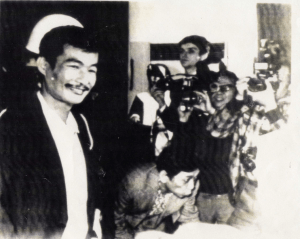
March 18, 1980: Shih Ming Te, charged with rebellion under a statute carrying a mandatory death sentence, walks into court in high spirits.
March 18, 1980, was the first day of the Formosa Military Trial. As he walked into the First Courtroom of the Taiwan Garrison Command at Jingmei, his radiant smile was that of a star graciously giving an interview. Had the photograph carried no caption, no one would have thought this man was about to be tried on a charge carrying a mandatory death sentence.
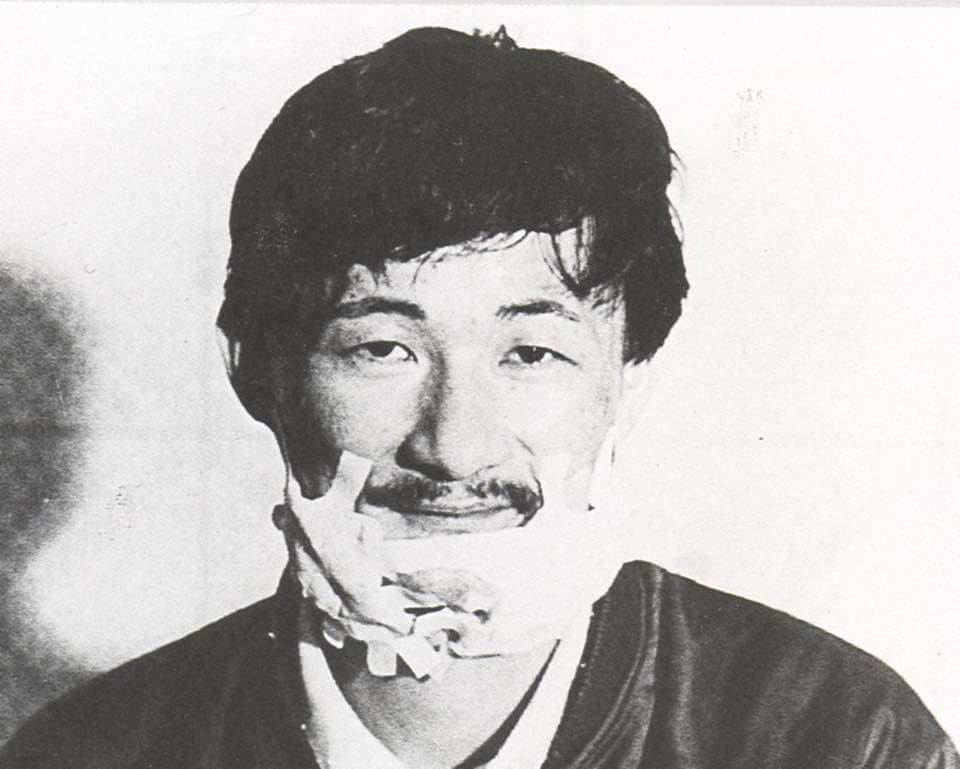
In fact, his smile first appeared in the first official photograph taken after his arrest on January 8, after twenty-six days on the run. His chin was then wrapped in gauze, and beneath the wound, the gauze, and the heavy pressure of arrest, we can see a faint smile. Huang Nien, then a reporter for the United Daily News and years later its editor-in-chief, called it “a strange smile.” If you asked Mr. Shih, he would tell you:
“I wanted to smile broadly, but when the agents arrested me, they were afraid I would swallow my dentures to kill myself, so they forcibly took out all my dentures. In this photo, I have no teeth.”
Whenever asked about his smile that year, Mr. Shih Ming Te said:
“I had no illusions; I knew death was right in front of me. I was a prisoner of conscience who had been jailed for fifteen years, a seasoned one. After my release I went on with the work of resistance; I knew what I was doing and what risk I was taking. Under dictatorship, secret police, and repressive rule — under the White Terror — people even breathed by the rules. My efforts were only a slender hope of shaking the indifferent, silent people, numbed by terror — if only they could throw off the shackles of fear, break free of the instinct of self-interest, and stand up against injustice. I had long since laid down my life; I had always lived without a self of my own. I smiled for you, longing for you to see hope amid the fear. Hope is the beginning of everything. At any time.”
— Shih Ming Te
1977: Mr. Shih Ming Te was a political prisoner who had once been sentenced to life imprisonment, his sentence commuted to fifteen years upon Chiang Kai-shek’s death. Under the commutation rules of the time, if within five years of release he were sentenced to two months or more of imprisonment, his life sentence would be restored. Throughout the Formosa political group era and the whole Tangwai movement, Mr. Shih Ming Te knew well that the risk he was taking was no longer a “chance” of the death penalty, but a certain, mandatory death sentence.
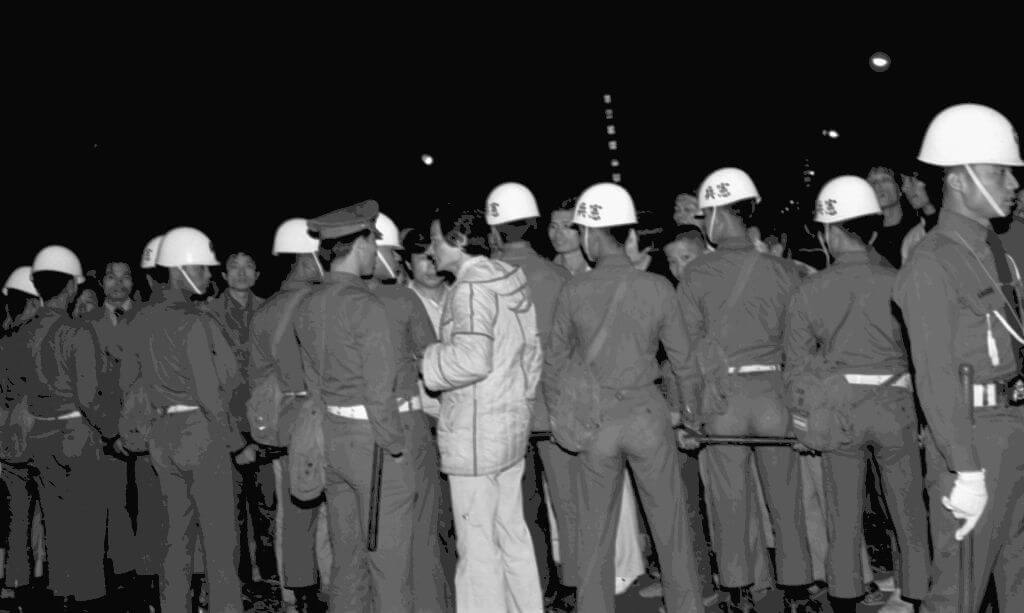
1979: Shih Ming Te, general manager of Formosa Magazine, facing off with military police in the street.
We interviewed Teng Tse-chuan, the investigator in charge of the Kaohsiung Incident case at the time. We asked whether they had tortured Mr. Shih to force a confession. He said: “Not much. Think about it — with someone like him, who looked on death as going home, what was there for us to ask? He simply wasn’t afraid.”
Taiwan’s history textbooks today say very little about Taiwan’s history, but they still include a photograph of the Formosa Military Trial. Many of you will remember from junior high or high school Mr. Shih Ming Te’s smile in that photograph. Since Mr. Shih’s release in 1990, the one question he has always been asked is why he smiled — when everyone else was so grave, tense, and grim.
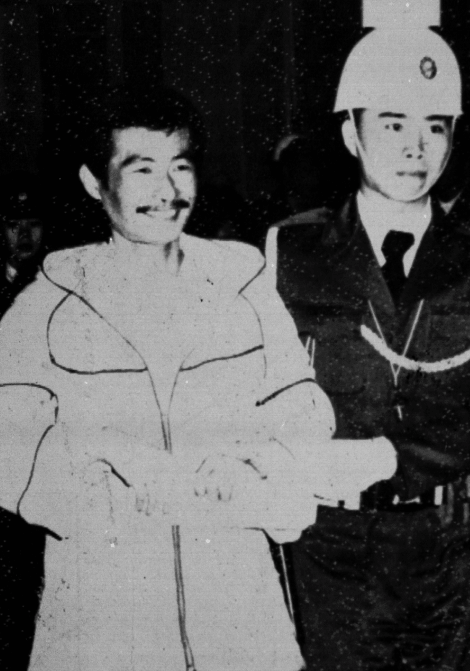
1980: He always faced the camera with a smile.
Mr. Shih says, first, that he was more experienced than the others; and more than that, he had understood since the age of sixteen that to take the road of resistance was to pay with one’s life. He says he never harbored any illusions; to resist takes courage precisely because the resister does not fear death.
He says that during his detention before the Formosa Military Trial, he did not trust his lawyers; he could not be sure they were not KMT plants. So he told his lawyers nothing, and did not let them know a single line of the statement he was preparing to read in court, insisting only that he would “remain silent.” In fact, of course, he had written “Shih Ming Te’s Political Will,” to read in court and leave to the people of Taiwan for generations to come.
His lawyer, Mr. You Ching, was anxious, afraid that Mr. Shih would remain silent and offer no defense. He told Mr. Shih that under international pressure, this would be a public trial. Mr. Shih finally heard the answer he had long been waiting for.
For Shih Ming Te, this final trial was like the last masterpiece of a great actor. As a resister, his death had to become nourishment and courage for generations to come.
And so Mr. Shih was determined to keep his easy, unbothered smile, to let the world see the national soul of the Taiwanese people and their courage to resist tyranny.
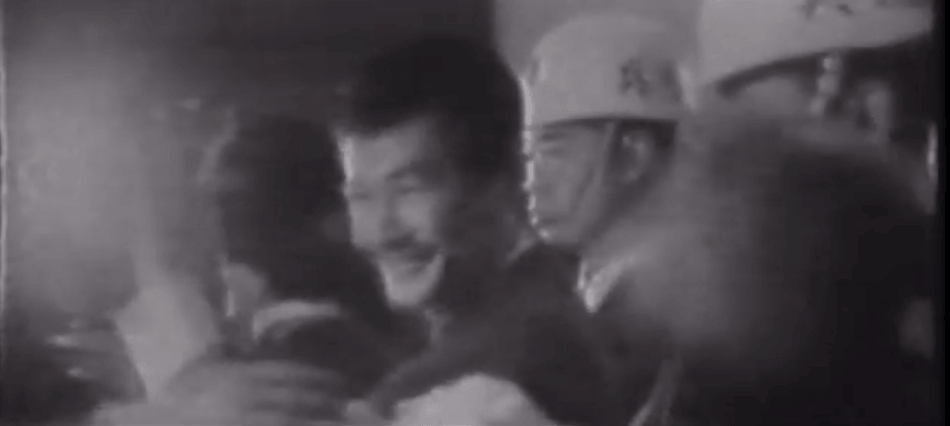
1980: This photograph is taken from a still of the TTV News footage of the time. Walking into court to stand trial, Shih Ming Te raises his hand and smiles in greeting to the people of Taiwan.
Facing the camera, he knew he was not looking at the next day’s front page; he was staring straight into the eyes of eternity, declaring to generation after generation of Taiwanese: we must be brave. And declaring to China: Taiwanese are not to be trifled with.
Study Mr. Shih’s life closely, listen carefully to his every word, and we find that there was one thing he cared about most throughout his life: China’s threat to Taiwan. We will say more about this in another story, which we invite you to read.
But as for the title of this piece, “The Secret Behind Shih Ming Te’s Smile,” let us conclude.
The smile meant he himself was not afraid.
It also told those he loved that they were not allowed to be afraid.
Just as when, as a child learning to ride a bicycle, wobbling and about to fall, you saw the smile on your mother’s face and all your fear was driven away.
The secret is courage — and love.