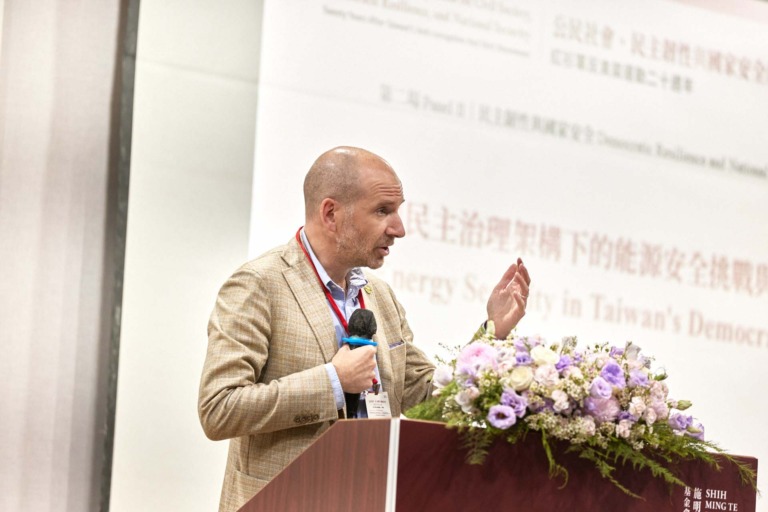
Mr. David Fedor
Stephenson Policy Fellow, Hoover Institution, Stanford University
David Fedor is the Stephenson Policy Fellow at the Hoover Institution, where he supports fellowship research within the George P. Shultz Energy Policy Working Group; Hoover’s national security–oriented Global Policy and Strategy Initiative; and the joint Hoover–Asia Society Working Group on Semiconductors and the Security of the United States and Taiwan. For nearly a decade, Fedor served on the Hoover staff of former US secretary of state George Shultz. Formerly at Asia-Pacific Economic Cooperation’s Asia Pacific Energy Research Center in Tokyo, Fedor has worked in economic and security policy analysis across the Indo-Pacific. He holds BS and MS degrees in Earth systems from Stanford University.
Abstract
One of the key challenges facing the world’s market democracies today is how much “insurance” to buy for the security and resiliency of their key inputs, their supply chains, and their infrastructure—including energy. Taiwan, like many of its Western peers, has developed an energy system focused on affordability, with a transformation plan that focuses largely on climate and the environment. But we are living in a more dangerous world. What options does Taiwan have to improve its energy security and reliability, and what are the particular challenges of attempting to do so within a robust, participatory democracy?
Speech

▪ Resilience as an Insurance Problem
During the Second World War, the United States came close to exhausting its supply of natural rubber after Japan’s capture of Singapore cut off most American access to this critical material. The vulnerability had been recognized well before the crisis. Policymakers understood the basic options: build larger stockpiles, cultivate alternative domestic sources, or develop synthetic substitutes. Yet each option appeared expensive or unattractive before the emergency arrived. When the crisis finally came, the United States was forced to pursue synthetic rubber at enormous cost and under severe time pressure.
The lesson is broader than rubber. The hardest part of resilience is often not identifying what should be done, but persuading a market democracy to act before the need becomes urgent. Investments in resilience can look wasteful in ordinary times because their value appears only when normal systems fail. The central policy question is therefore how much “insurance” a democracy should purchase for the security of its key inputs, supply chains, and infrastructure.
Energy policy presents this problem especially clearly. George Shultz often described energy policy as resting on three legs: economics, the environment, and security. All three matter, but security becomes binding first when systems come under stress. The challenge is that security and resilience are difficult to measure and price. Market democracies therefore tend to underinvest in them unless political leaders can explain why paying an additional cost today reduces a much larger risk tomorrow.
▪ Taiwan’s Energy System: Strengths and Structural Constraints
Taiwan shares many of the energy priorities of other industrialized democracies. Affordability is essential to industrial competitiveness. Climate and environmental goals have become increasingly important, especially among younger citizens. At the same time, energy security is an unusually serious concern because Taiwan has very limited indigenous fuel resources. As of 2025, imported energy accounted for roughly 97 percent of total energy consumption.
High import dependence by itself is not unique in East Asia. Japan, South Korea, and Singapore also rely heavily on imported energy. Taiwan, however, faces additional constraints. Its energy sector has historically been organized around state-owned firms with large roles in generation, transmission, distribution, fuel supply, and retail. That structure has supported reliable and relatively low-cost service, but it can also make major institutional and investment transitions difficult.
Taiwan’s geography creates further constraints. Its limited land area and high population density restrict the large-scale deployment of onshore wind and ground-mounted solar that is available in larger economies. Offshore wind and rooftop solar can play important roles, but they are generally more complex and costly to develop. Nuclear power has also been politically contested and has been phased down earlier than its technical operating life might otherwise have implied.
These constraints should not obscure the strengths of the system. Taiwan has maintained a professionally managed energy infrastructure in a difficult physical environment. Taipower, CPC, the Ministry of Economic Affairs and its Energy Administration, and other institutions have continued to expand fuel storage, develop new gas-fired generation, and adjust regulations as conditions change. Recent revisions to offshore-wind rules and local-content requirements also show a capacity for pragmatic policy adaptation.
▪ Expanding the Energy Option Set
The central concern is that Taiwan’s energy choices have become too constrained from an engineering and resilience perspective. There are good reasons to question individual technologies or projects, and there are no easy solutions. But resilience generally improves when policymakers preserve a wider range of technological options rather than narrowing the system too early.
Diversification is therefore a first principle. Power-system modeling in other settings suggests that when a system must satisfy several objectives at once—cost, emissions, reliability, and security—a broader technology portfolio can reduce overall costs and improve flexibility. For Taiwan, this argues for keeping as many viable options on the table as possible.
In my own view, that includes reconsidering nuclear power. The political meaning of nuclear energy in Taiwan has changed over time. Where it was once associated by some with authoritarian governance, it can now also be understood as a potential source of resilience within a democratic system. The renewed interest in nuclear power in the United States also creates opportunities for future U.S.–Taiwan cooperation in this area.
Fuel infrastructure is equally important. Taiwan needs greater LNG import capacity and additional storage. Options such as underground gas storage deserve more serious consideration, including the possibility of using depleted reservoirs such as Tiehchenshan, together with the pipeline and distribution investments necessary to make such storage useful. The difficult question is how to finance assets whose value lies partly in being available during emergencies rather than in generating returns every day.
▪ Democratic Governance and the Politics of Building
The most difficult energy-security questions are ultimately political rather than technological. Taiwan must strengthen resilience through a robust participatory democracy, not around it. That makes public legitimacy essential—but participation cannot mean giving every small group an effective veto over infrastructure that serves a broader public need. If democratic systems become structurally unable to build, authoritarian systems will gain an important advantage.
The task is to incorporate genuine local concerns while preserving the ability to make long-term decisions for the common good. This requires political leadership capable of explaining trade-offs clearly. In an environment shaped by foreign information manipulation and domestic distrust, governments may be tempted to reassure citizens that everything is under control. Yet that approach makes it harder to explain later why additional infrastructure, higher costs, or local burdens are necessary.
Taiwan has already demonstrated that democratic publics can adjust to difficult security realities. Over the past decade, public debate on national defense has shifted as the country reconsidered weapons acquisition, force structure, and conscription. Energy security now requires a similar process of public education: a clearer account of vulnerabilities, a more explicit discussion of trade-offs, and a shared understanding of what greater resilience will cost.
▪ Planning for Contingencies
One practical step would be to develop an explicit energy-security plan alongside Taiwan’s net-zero strategy. The question should not be whether climate policy should be abandoned, but what a system designed around security and resilience would look like, and where its priorities would differ from the current pathway.
Japan offers one useful model. Rather than relying on a single energy trajectory, policymakers can communicate in advance the conditions under which a country would move from a preferred plan to a contingency plan. Establishing performance thresholds beforehand makes adaptation more predictable and gives the public a clearer role in understanding the trade-offs before a crisis occurs.
Taiwan could also consider a dedicated budget for energy resilience, analogous to special expenditures for defense and broader national security. Such a mechanism would make visible the fact that resilience is a public good with costs that may not be justified by ordinary commercial criteria alone. The point is to treat energy infrastructure as part of national resilience rather than only as a utility-sector investment.
▪ Energy Security and Taiwan’s Strategic Importance
These questions matter beyond Taiwan itself. Taiwan’s energy security is increasingly connected to the economic and national-security interests of the United States and other advanced democracies. Taiwan’s role in the semiconductor and AI supply chains means that disruption to the island’s energy system would have consequences far beyond its borders.
This interdependence creates both an opportunity and an obligation. Taiwan’s partners have strong reasons to support greater energy resilience, but the choices themselves must ultimately be made through Taiwan’s democratic institutions. The country must decide which technologies, infrastructure investments, and contingency measures it is willing to support—and how much it is prepared to pay for them.
The central lesson is the same one illustrated by the wartime rubber shortage: resilience is cheapest and most effective when it is purchased before the emergency. Taiwan has considerable institutional capacity, technical expertise, and public awareness on which to build. The challenge now is to broaden the range of options, explain their costs honestly, and make the investments necessary before circumstances remove the luxury of choice.