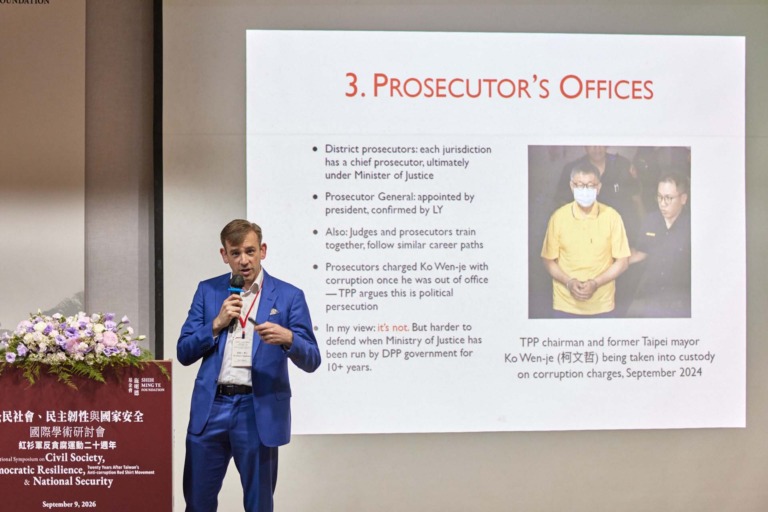
Dr. Kharis Templeman
Research Fellow, Hoover Institution, Stanford University
Program Manager, Project on Taiwan in the Indo-Pacific Region Lecturer,
Center for East Asian Studies, Stanford University
Kharis Templeman is a Research Fellow at the Hoover Institution and program manager of the Project on Taiwan in the Indo-Pacific Region, as well as a lecturer in the Department of East Asian Studies at Stanford University. A political scientist by training, he writes and speaks frequently about cross-Strait relations and Taiwan politics and policy issues.
Dr. Templeman has edited three book volumes: Taiwan’s Democracy Challenged: The Chen Shui-bian Years and Dynamics of Democracy in Taiwan: The Ma Ying-jeou Years (both with Larry Diamond and Yun-han Chu), and Electoral Malpractice in Asia: Bending the Rules (with Netina Tan). His other research has been published in Comparative Political Studies, Electoral Studies, Ethnopolitics, Journal of Democracy, International Journal of Taiwan Studies, and Taiwan Journal of Democracy, along with several book chapters. He has also written on Taiwan policy issues for the Brookings Institution, Atlantic Council, Foreign Affairs, Taiwan Insight, War on the Rocks, and The Diplomat. His current research agenda includes work on China’s Taiwan policy, the drivers of defense spending in Taiwan, and Taiwan’s party system evolution after the transition to democracy. Dr. Templeman holds a B.A. from the University of Rochester and a Ph.D. in political science from the University of Michigan.
Abstract
In May 2024, President Lai Ching-te took office while facing off against an opposition party majority in the legislature. Since then, Taiwan has been caught in a slowly escalating constitutional crisis. The Constitutional Court is now paralyzed, key regulatory bodies sit vacant, the annual budget bill is a half-year late, and the premier has refused to countersign legislation. This political dysfunction has been blamed on nationalist polarization, PRC influence, or reckless and irresponsible opposition parties, but these explanations overlook a simpler cause: Taiwan’s institutions are simply not well-designed to handle divided government. The political system lacks adequate safeguards to protect the independence of accountability institutions. Unified government masked this design flaw for many years, but it now threatens Taiwan’s democracy.
Speech

▪ Taiwan’s Democratic Paradox
Taiwan is widely regarded by comparative measures as a high-quality liberal democracy. Freedom House, the Bertelsmann Transformation Index, the Economist Intelligence Unit’s Democracy Index, and V-Dem all place Taiwan relatively high in comparative perspective. By these measures, Taiwan looks like one of the stronger democracies to emerge from the third wave of democratization.
Yet this comparative picture sits uneasily beside Taiwan’s domestic politics since 2024. President Lai Ching-te took office in May 2024 without a legislative majority, leaving the executive in the hands of the Democratic Progressive Party (DPP) and the legislature controlled by an opposition majority. Since then, political conflict has repeatedly escalated across institutions. There have been mass protests, confrontations in the Legislative Yuan, an attempted mass recall of legislators, an opposition effort to impeach the president, and increasingly serious disputes over the constitutional authority of the executive and legislature.
The institutional consequences have been more troubling than the visible partisan conflict. The Constitutional Court has become effectively paralyzed because it lacks the membership required to issue binding decisions. The National Communications Commission (NCC), which oversees broadcast media, has been left without commissioners. The premier has declined to countersign legislation passed by the Legislative Yuan, creating a major dispute over the scope of executive authority. These developments raise a basic puzzle: how can a democracy that performs so well on comparative measures simultaneously exhibit such severe institutional dysfunction?
The usual explanations focus on partisan polarization, cross-Strait nationalism, PRC influence, or irresponsible behavior by one side or the other. My argument is different. Taiwan certainly is polarized, and external influence is a real concern, but the current crisis is fundamentally institutional. Taiwan’s political system is not well designed to manage divided government. For many years, unified government concealed these weaknesses. Divided government has now exposed them.
▪ Divided Government as an Institutional Stress Test
Taiwan has experienced divided government before. The most important earlier period was the Chen Shui-bian presidency from 2000 to 2008, when the DPP controlled the executive while opposition parties held a majority in the legislature. That period is especially relevant because many significant institutional reforms were adopted during those years.
The National Assembly was abolished through constitutional amendment. The electoral system for the Legislative Yuan was changed. The rules governing the Constitutional Court, including the terms and appointment process for its justices, were revised. The NCC and other independent bodies were created or redesigned. Yet many of these reforms did not take full effect until 2008 or later.
From 2008 through 2024, Taiwan then experienced sixteen years of unified government: first under the Kuomintang (KMT) during the Ma Ying-jeou administration and then under the DPP during the Tsai Ing-wen administration. During that period, the executive and legislative branches were generally controlled by the same party. Institutional disagreements could therefore often be resolved within the governing party rather than through formal constitutional mechanisms.
This meant that many of the reforms adopted during the previous era of divided government were never seriously tested under conditions of sustained interbranch conflict. The political system now faces that test. The difficulties Taiwan has experienced since 2024 suggest that the problem is not simply unusually intense partisan behavior. Some degree of executive-legislative conflict is exactly what we should expect when different parties control institutions that possess independent democratic mandates. The deeper question is whether the constitutional system contains workable mechanisms for managing that conflict.

▪ Strong Presidentialism and Competing Democratic Mandates
Although Taiwan is formally classified as a semi-presidential system, in practice it increasingly resembles a strong presidential regime. The president is directly elected, the legislature is directly elected, and the premier is politically accountable primarily to the president rather than to the legislature. In practical terms, the premier generally acts as an agent of the president.
Comparative research on presidential systems has long identified a potential source of conflict in this arrangement: both the executive and the legislature can claim an independent democratic mandate. That tension is particularly visible in Taiwan today. The DPP can point to its victory in the presidential election, while the opposition can point to its majority in the Legislative Yuan. Neither side possesses an overwhelming popular mandate. President Lai won the presidency with roughly 40 percent of the vote, while the KMT’s legislative plurality also rested on about 40 percent of the district vote. Yet both sides can plausibly claim to represent a substantial share of the electorate.
The result is not simply partisan disagreement but a conflict between two institutions that each possess democratic legitimacy. Under unified government, party discipline can soften this tension. Under divided government, each branch has incentives to assert its own authority and use whatever institutional advantages are available to it. Constitutional confrontation is therefore not an anomaly in such a system; it is a predictable possibility.
▪ Why the Existing Escape Mechanism Does Not Work
Taiwan does contain a formal mechanism for resolving severe conflict between the executive and legislature: a vote of no confidence. In principle, the legislature can bring down the cabinet. The president, however, can respond by dissolving the legislature and calling new elections.
That reciprocal threat makes the mechanism difficult to use. Legislators who vote no confidence risk immediately having to defend their seats in a new election. As a result, an opposition majority may have little incentive to trigger the mechanism even when conflict with the executive has become severe. The formal escape valve exists, but its political incentives discourage its use.
Taiwan can therefore become trapped in prolonged interbranch conflict without an effective means of resetting the political system. The branches continue to challenge one another, while the institutions that should resolve disputes become increasingly important. That makes the independence, credibility, and continuity of Taiwan’s constitutional referees essential.
▪ The Need for Independent Referees
When the executive and legislature are controlled by opposing political forces, a democratic system needs institutions capable of adjudicating disputes without becoming extensions of either side. Courts, election authorities, regulatory commissions, prosecutors, and other accountability bodies must be insulated from partisan retaliation and, just as importantly, must be designed to continue functioning even when political actors cannot agree on appointments.
This is where Taiwan’s current institutional framework is especially vulnerable. Several formally independent bodies depend on appointment procedures that require cooperation between institutions controlled by different parties. When that cooperation breaks down, the default outcome is too often not continuity but institutional paralysis. A disagreement over appointments can therefore disable the very institution needed to manage political disagreement.
▪ The Constitutional Court
The Constitutional Court illustrates this problem clearly. It is the institution best positioned to adjudicate disputes over the constitutional powers of the executive and legislature, including the dispute over whether the premier may refuse to countersign legislation. Yet the Court itself has been unable to function normally because vacancies have left it below the required quorum for binding decisions.
The design of judicial appointments also creates a long-term credibility problem. Constitutional Court justices serve eight-year, nonrenewable terms, while presidents serve four-year terms. A president who wins reelection can therefore, over two terms, nominate the entire membership of the Court. Under both the Ma and Tsai administrations, this produced courts whose members had all been appointed during the tenure of the same governing party.
This does not mean that individual justices act as party agents. The institutional problem is one of perception and incentives. Even if judges behave professionally and independently, a system in which all members of the Court can be identified with appointments made under one party makes it easier for opponents to question the Court’s neutrality. Under divided government, that perception becomes especially damaging precisely when an authoritative and broadly trusted constitutional referee is most necessary.
▪ The National Communications Commission and the Prosecution System
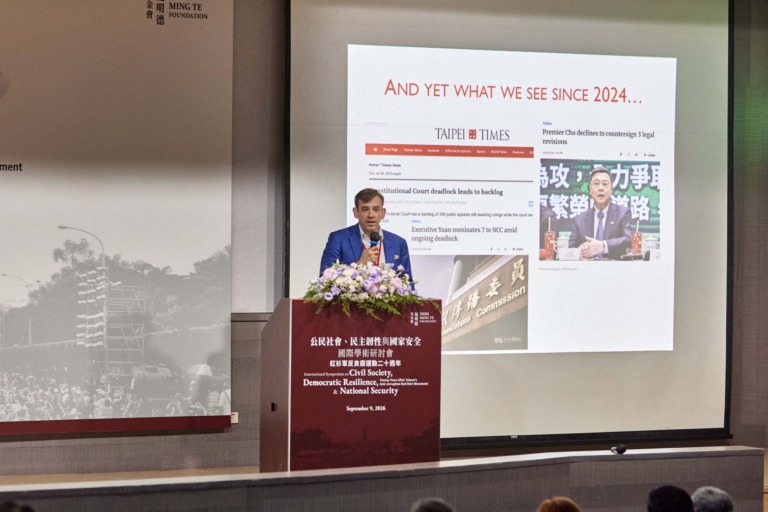
The National Communications Commission presents a related but even more direct problem. The NCC was created as an independent agency and oversees Taiwan’s broadcast media. Commissioners serve fixed terms, are nominated by the executive, and require legislative confirmation. Under divided government, this creates a straightforward path to deadlock: the executive nominates, the legislature rejects, and the positions remain vacant. The result is not merely disagreement over who should serve but an agency that can cease to function altogether.
A similar, though less severe, tension exists in the prosecution system. The Ministry of Justice oversees prosecutors, while the prosecutor-general is appointed by the president and confirmed by the legislature. When confirmation fails and an acting appointment is used instead, questions about institutional independence become more difficult to resolve. Those questions become particularly sensitive when prosecutors pursue cases involving prominent opposition politicians.
The point is not that such prosecutions are necessarily politically motivated. Rather, institutional design should make it easier, not harder, for citizens across party lines to believe that prosecutorial decisions are independent. Long periods of single-party control over the executive can weaken that perception even when individual officials act professionally.
▪ Institutional Strengths Taiwan Can Build On
Taiwan’s current difficulties should not obscure the fact that several important institutions have remained resilient and comparatively nonpartisan. The central bank retains substantial autonomy and has not been subjected to the kind of direct political interference in monetary policy seen in some other countries. The Central Election Commission has maintained enough institutional continuity to administer elections. Taiwan’s police administration also continues to enjoy a reputation for professionalism and relative political neutrality.
These cases matter because they suggest that the broader problem is not inevitable politicization. Taiwan already possesses institutions that have maintained independence across changes in government. Reform should therefore examine why these institutions have been more resilient and whether similar safeguards can be adapted to bodies that are currently vulnerable to appointment deadlock or partisan contestation.
▪ Conclusion: Designing Institutions for Disagreement
Taiwan remains a strong democracy by comparative standards, but its current political deadlock has exposed significant weaknesses in its institutional design. The central problem is not that political parties disagree. Divided government necessarily produces conflict between actors with competing democratic mandates. A durable constitutional system must be designed on the assumption that such disagreement will occur.
For much of the period from 2008 to 2024, unified government masked these vulnerabilities because disputes could often be resolved within the governing party. Since 2024, divided government has revealed how dependent several key institutions are on cooperation between actors who may have strong incentives not to cooperate. When that cooperation fails, the fallback cannot be that the Constitutional Court, the NCC, the Control Yuan, or another accountability institution simply stops functioning.
Strengthening Taiwan’s democratic resilience therefore requires institutional reforms that protect the independence of accountability bodies while ensuring continuity when nominations or confirmations are blocked. The immediate controversies are partisan, but the underlying problem is constitutional. Taiwan’s challenge is to build institutions that can continue to operate precisely when political agreement is hardest to achieve.