
In 1978, a man named “Hsu Yi-wen” published “A Modest Proposal for Establishing a Fourth Central Parliament” in The Generation magazine, later reprinted as a pamphlet. He criticized the Legislative Yuan and the National Assembly, whose members had not stood for re-election in thirty years, calling them the “Ten-Thousand-Year Parliament,” and attacked forcefully the Chiang family’s dictatorial, anti-democratic, and anti-human-rights measures — and narrowly escaped arrest once again. The article was the first to use the term “Ten-Thousand-Year Parliament,” and from then on the phrase became the most incisive label the Tangwai and intellectuals used to criticize the Chiang family’s dictatorship.
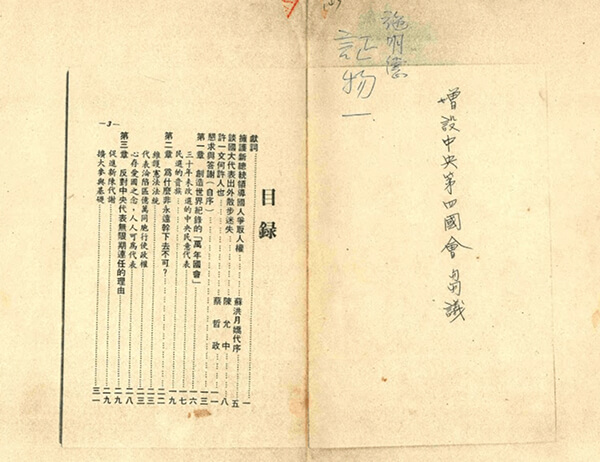
Who was Hsu Yi-wen? In the pamphlet published afterward, Tsai Che-cheng wrote an author’s introduction. And who was Tsai Che-cheng? It was a complicated era, and everything had to be done under code names. Tsai Che-cheng was Chiou I-jen; Hsu Yi-wen was Shih Ming Te.
“During last year’s campaign for the five categories of public office, I came to know Brother Hsu in Beigang. I sensed in him then the courage one must have to take part in real politics in an environment like Taiwan’s. As I came to know him better, I found that he also had the wisdom, sense of right and wrong, and extraordinary perseverance that taking part in real politics requires.”
— Chiou I-jen (Tsai Che-cheng)
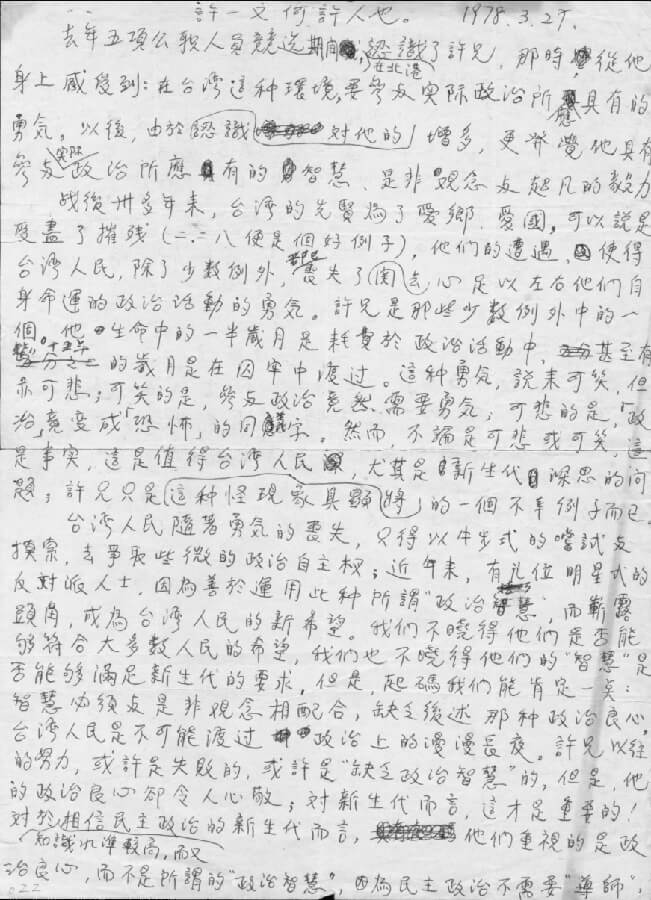
Chiou I-jen’s 1978 manuscript of the author’s introduction, “Who Is Hsu Yi-wen?”, for the pamphlet A Modest Proposal for Establishing a Fourth Parliament.
Why would a political prisoner — sentenced to life imprisonment, released after his sentence was commuted to fifteen years, on condition that violating any law carrying a sentence of two months or more would restore the life sentence — still concern himself with something as perilous as politics? Knowing it would be banned, why would he still analyze and criticize, with such clarity, the greatest “cancer” of the politics of the day — the Ten-Thousand-Year Parliament? Few can answer that question. It simply happened.
In the 1980s, while Shih Ming Te was on hunger strike in prison — after martial law was lifted and prisoners were finally allowed to correspond — attorney Lee Ching-hsiung wrote to him:
“… Recently I reread the ‘Fourth Parliament’ you wrote more than ten years ago, and was astonished by your grounding in political science and law. I feel it is unjust that some people regard you only as a ‘street activist.’ … If the KMT government had accepted your proposal back then, it would not be in such a sorry state today.”
— Lee Ching-hsiung
Put simply, Shih Ming Te’s “Fourth Parliament” proposal sought a way out of the political dictatorship and institutional rigidity caused by a parliament — its three chambers: the Legislative Yuan, the National Assembly, and the Control Yuan — that had not stood for re-election in thirty years under the “Period of National Mobilization for Suppression of the Communist Rebellion” system. Asked about its “feasibility,” he replied:
“I think the number of chambers is not important. Whether there is a precedent is not important either. What matters is that we really have reached a bottleneck that is hard to break through, and we cannot let this bottleneck bind us, suffocate us, and finally destroy and bury us! We must have some way to solve it. It was in order to solve the problem while keeping the larger picture in view that I designed the new concept of a Fourth Parliament.”
— Shih Ming Te
At the end of the pamphlet, Shih wrote a passage in a style that is typically his. He knew what he was pursuing; he knew why he was exercising restraint. As he often cautioned his own children: it is not that Taiwanese are not brave, not that we could not be like Che Guevara and his comrades; it is that, besides resisting the dictatorship of the Chinese Nationalist Party at home, we must also resist the territorial ambitions of the Chinese Communist Party from outside. We must always be careful and prudent.
“Finally, I would still like to share a thought with progressive people. Whether in facing the ‘Ten-Thousand-Year Parliament’ or other national issues still awaiting a breakthrough, so long as real reform can be achieved, what harm is there in making concessions, even in appearing somewhat weak? One more measure of forbearance today may be the very foundation of one more measure of history’s praise tomorrow. If the old representatives are determined to hold on to today, then let us win history!”
— Shih Ming Te
Yet even so moderate, rational, and sincere a proposal on national affairs was intolerable in the eyes of the dictator Chiang Ching-kuo, and the “old thieves” were gravely concerned. They immediately banned the pamphlet, and word spread that Shih Ming Te would be arrested. What could be done? That is why Linda Gail Arrigo and Shih Ming Te hurried to the American consulate to register their marriage, and then sought help from the U.S. government and international human rights organizations. This time Shih Ming Te escaped arrest. He later joked that it was “the thirty-seventh stratagem: marry a foreigner to save your skin.”
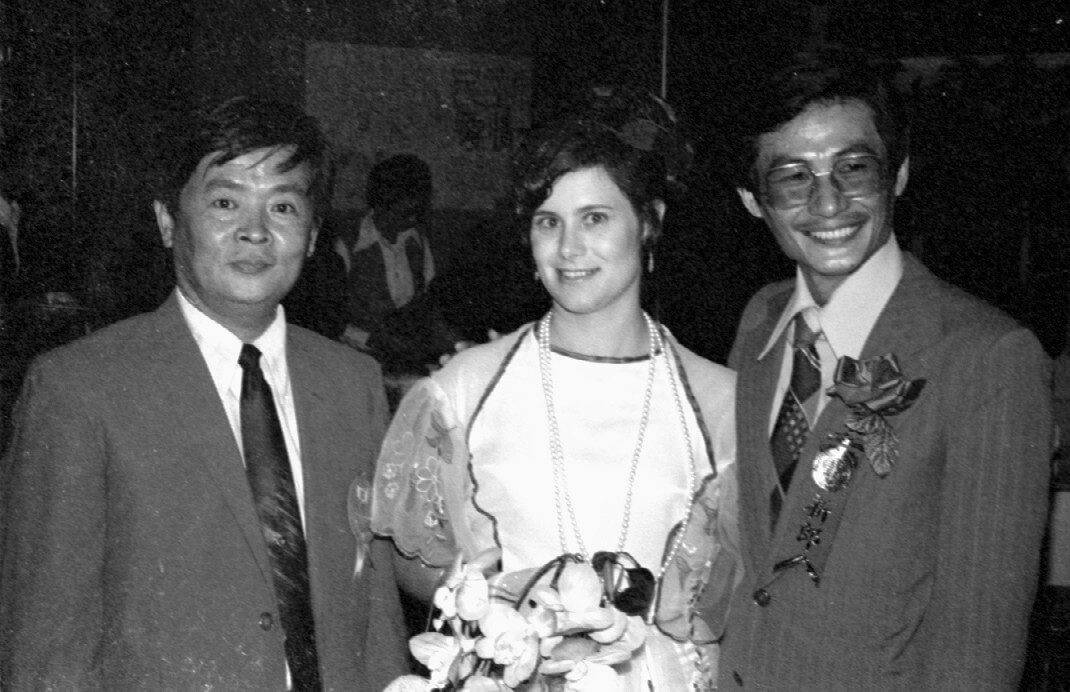
The wedding of Shih Ming Te and Linda Gail Arrigo. First from left is Mr. Chen Po-wen, Shih Ming Te’s close friend, then known by the code name Chen Yun-chung. He funded the publication of the pamphlet, and could be called the matchmaker of this wedding.