
“Power has its limits; only influence reaches without bound.” — The Commander’s Confessions, pp. 82–83
September 9, 2006, Ketagalan Boulevard. The crowd lifted a sixty-five-year-old man high into the air. Just two months after surgery for liver cancer, he stood at the center of the sea of people and raised his right fist.
What that moment calls us to ask is not about its force, but a more fundamental question: by what authority did he lead these people?
When he launched the movement, Shih Ming Te was not a party chairman, not an elected representative, not the head of any organization. He was a private citizen. He had no party machine, no public authority, not a single dollar of mobilization budget. When he said he would gather a million people, no one in either the Blue or the Green camp thought he could, commentators were uniformly pessimistic, and the public jeers were that he “overrated himself” and “would be lucky to get three thousand.”
He had done the arithmetic himself. In an army, every nine soldiers need a squad leader, every three squads a platoon leader, and so on up the chain: how many officers would a million people need? When Chiang Kai-shek came to Taiwan, his army at its height numbered only six hundred thousand — and how many generals were there to lead it? Beneath the Red Shirts, there was not even a complete mobilization organization.
His conclusion: he could not rely on power; he could rely only on influence.
And where does influence come from? He put it plainly — influence does not come from authority, position, money, or office. It rests on the reputation built up by a lifetime’s deeds, and on people’s belief that a man will not sell out the people for his own fame and gain. That reputation had been accumulating since 1959, the year he applied to military academy, resolved to overthrow the Chiang family dictatorship — by then, fifty years.
“Power can be handed over; reputation cannot be inherited.” These were his words in court.
And precisely for this reason, his opponents chose the most efficient line of attack. They did not debate corruption; they attacked his character — from “political gigolo” to “selling out Taiwan” to his private life, a campaign of smears on every front. To catch the bandits, first catch their king: the fastest way to destroy a civic movement is to destroy its leader.
Twenty years later, this remains a question every democratic society must face: when a person holds no legal authority whatsoever, why are people willing to follow him? If the answer is reputation, then how reputation is built and how it is destroyed is not merely one man’s fortune, but a condition for the survival of civil society.
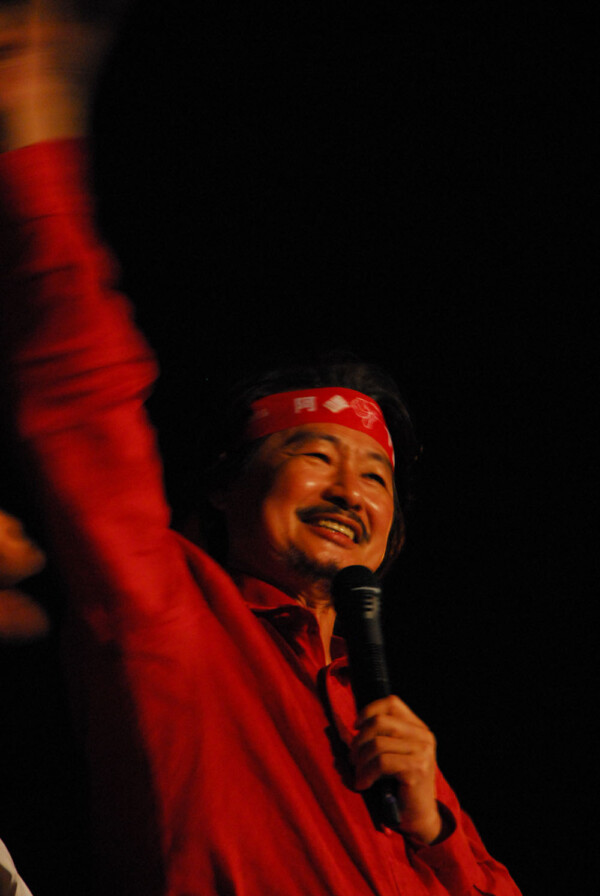

September 9, 2006, Ketagalan Boulevard. The people lift the scepterless “commander-in-chief” high.
Source: Shih Ming Te, The Commander’s Confessions, 2009, pp. 82–83, 134–141. The quotation is from “On the Brink of Civil War: Final Statement at the Red Shirt Trial.” A similar statement with slightly different wording appears on p. 136; this piece uses the original sentence from the defense statement.

Want to learn more about the Red Shirt Movement and the innermost confessions of its commander-in-chief, Shih Ming Te?
Click here to read more about The Commander’s Confessions and get your copy.
On September 9, 2026 — twenty years to the day after the Red Shirts took Ketagalan Boulevard — the Shih Ming Te Foundation will host the International Symposium on Civil Society, Democratic Resilience, and National Security: Twenty Years After Taiwan’s Anti-Corruption Red Shirt Movement, to face the most important challenge before Taiwan today: how to defend the values and way of life we hold fast to!