
“This mountain man has a clever plan of his own.” — The Commander’s Confessions, pp. 92–93
For the movement to hold, it had to last through the night. If the crowd were cleared every evening and regathered the next day, it would not be a siege — only a rally.
And whether it could stay overnight was not up to Chen Shui-bian. It was up to the Mayor of Taipei.
The precedent was only two years old. After the 3/19 shooting in 2004, there had also been a sit-in in front of the Presidential Office, and the one who finally dispersed the crowd was not the president but the Mayor of Taipei, acting under the law. The same man was now chairman of the largest opposition party and the most likely next president. And the common view was that the worse Chen Shui-bian looked, the better for him: as long as Chen did not step down, he would drag down the DPP’s next candidate.
At an internal meeting, the movement’s organizers asked: what if he does the same thing again?
Shih Ming Te’s answer was six characters long: “This mountain man has a clever plan of his own.”
The plan was this. On the day they took Ketagalan Boulevard, he would carry a bag of gasoline on his body and a lighter in his pocket. Then he would see whether the authorities dared, before the cameras of the world’s media, to order riot police to charge in and disperse a crowd of unarmed, peaceful anti-corruption protesters — at the very front of whom stood a political prisoner who had served twenty-five years, carrying gasoline.
His reasoning was simple: if the cost were high enough, the order would never be given.
In July 2006, people were tasked with buying professional bags that could hold gasoline. One of them was his good friend Ni Chung-hua.
There is a contrast here that must be seen clearly. This was a movement that had pledged peace and non-violence to a million people. Every day, every hour, the crowd recited the oath: I will allow no violence between me and my true heart. And the last resort the commander-in-chief privately prepared was a form of violence — except that it was aimed entirely at himself.
In the history of protest around the world, self-immolation has mostly been martyrdom: death itself as the indictment. Shih Ming Te’s calculation was different. He did not intend to die. He was creating a cost the other side could not bear, so that the order to clear the crowd would never come. This was deterrence, not sacrifice.
And the two are not in contradiction. Precisely because he would not allow the crowd to bear any risk, he had to stand in that position himself.
The gasoline bag was never used. After September 9, the police made no move to clear the crowd. That prop, never put to use, shows the real cost of non-violence: it is neither passive nor mild. It requires someone ready to bear a cost higher than violence itself — and to let no one know.

2006: Shih Ming Te at a press conference.
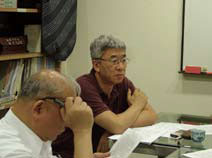
July 2006: Ni Chung-hua, who was tasked with buying the gasoline bag.
Source: Shih Ming Te, The Commander’s Confessions, 2009, pp. 88–93, 124–125. The quotation is from “On the Brink of Civil War: Final Statement at the Red Shirt Trial”; pp. 124–125 of the book add a note making clear that the “clever plan” referred to carrying the gasoline bag.

Want to learn more about the Red Shirt Movement and the innermost confessions of its commander-in-chief, Shih Ming Te?
Click here to read more about The Commander’s Confessions and get your copy.
The decision records, staff meeting documents, and images of the Red Shirt Movement are being preserved and catalogued by the Shih Ming Te Foundation.
The Shih Ming Te Foundation needs your support.