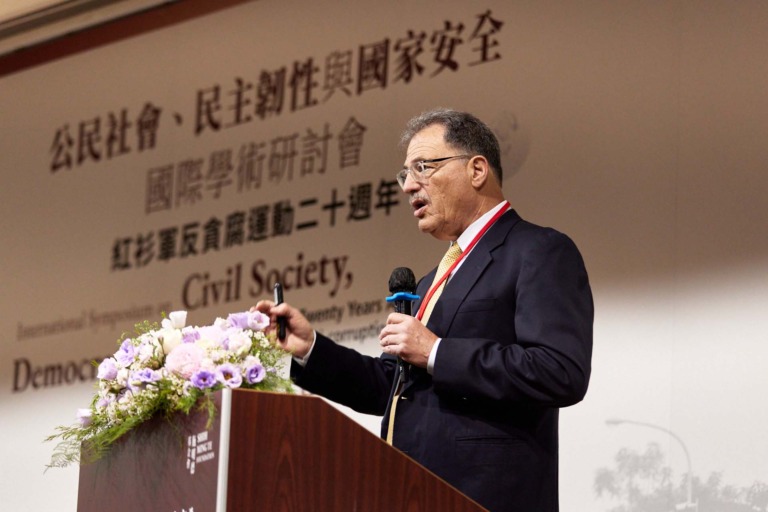
Prof. Larry Diamond
William L. Clayton Senior Fellow, Hoover Institution
Mosbacher Senior Fellow in Global Democracy, Freeman Spogli Institute for International Studies, Stanford University
Larry Diamond is the William L. Clayton Senior Fellow at the Hoover Institution and the Mosbacher Senior Fellow in Global Democracy at the Freeman Spogli Institute for International Studies (FSI). He is also Professor by Courtesy of Political Science and Sociology at Stanford. He co-chairs the Hoover Institution’s project on Taiwan in the Indo-Pacific Region with Admiral (Ret.) James O. Ellis, Jr. He has co-edited several books on Taiwan and has visited the country regularly since 1995.
Diamond’s research focuses on democratic trends and conditions around the world and on policies and reforms to defend and advance democracy. His book, Ill Winds: Saving Democracy from Russian Rage, Chinese Ambition, and American Complacency, analyzes the challenges confronting liberal democracy at this potential “hinge in history.” He is author of six other books, including The Spirit of Democracy and Developing Democracy: Toward Consolidation, and he has edited or co-edited 55 other books.
Diamond served from 1990 to 2022 as the founding coeditor of the Journal of Democracy and co-chaired the International Forum for Democratic Studies of the National Endowment for Democracy from 1994 to 2009. From 2009 to 2015 he served as Director of Stanford’s Center on Democracy, Development and the Rule of Law.
Abstract
Beginning around 2006, the world fell into a democratic recession that has now lasted for two decades, morphing into a “third reverse wave of authoritarianism.” During this period, levels of freedom have declined in every region of the world, and many of the world’s most influential democracies have experienced democratic backsliding and even a descent into some form of authoritarian rule.
The most common form of democratic deterioration has involved rising political polarization and the emergence of illiberal populist leaders and parties who, on taking power, have eroded checks on executive power, civil liberties, and the rule of law. The trend has affected not only major emerging market democracies but also advanced democracies like the United States.
This presentation documents the trend, explains its causes, and identifies the strategies needed to halt the authoritarian slide and renew democratic momentum. Political parties and civil society actors in backsliding countries must unite around political strategies and coalitions to defeat populist authoritarianism, and the wealthy and powerful democracies of Europe, North America, and East Asia must develop new initiatives, confidence, and resolve to counter the shift in global power to autocracies like China and Russia.
Speech

It is a great honor to be here. My own engagement with Taiwan goes back several decades. When I lived here in the 1990s studying Taiwan’s democratization, I had the privilege of interviewing Shih Ming-teh. What struck me then, and even more as I later learned about his life, was his extraordinary commitment to democratic principle.
Shih spent much of his early life as a political prisoner, yet he emerged from that experience without allowing bitterness or vengeance to define his politics. Throughout his later career—as a legislator, a leader of the Democratic Progressive Party, and an advocate for political accountability—he repeatedly demonstrated that democratic principles must stand above partisan loyalty. His role in the anti-corruption movement of 2006 was particularly revealing in this respect. He was willing to demand accountability even when doing so meant challenging a president from his own political camp.
That legacy speaks directly to the subject of this presentation. Democracy cannot be sustained without accountability, transparency, the rule of law, and a willingness to defend democratic principles even when doing so is politically inconvenient.
▪ The Global Democratic Recession
For roughly two decades, the world has been experiencing what I have called a global democratic recession. Today, however, the term “recession” may no longer be sufficient. We are witnessing something more serious: an authoritarian wave marked by the rise of illiberal populism, the erosion of democratic institutions, and growing assaults on political and civil freedoms.
Several broad trends define this period.
First, democracy and political freedom have declined globally. Since around 2006, the proportion of countries that can reasonably be classified as electoral democracies has fallen, while political rights and civil liberties have deteriorated across many regions.
Second, the rule of law has weakened. Democratic decline is not confined to the Global South or to relatively young democracies. Established democracies have also experienced serious institutional deterioration, including the United States.
Third, the most consequential contemporary form of democratic backsliding has been the rise of illiberal and, ultimately, authoritarian populism. In many countries, leaders have come to power through elections and then used that democratic mandate to weaken the institutional constraints that make democracy meaningful.
Fourth, political polarization and intolerance have intensified. Social media has magnified these divisions, creating an environment in which disinformation, resentment, and identity-based hostility can circulate rapidly and at enormous scale.
Fifth, democratic systems increasingly face external interference from powerful authoritarian states. China and Russia have developed a range of influence operations, financial and political interventions, information manipulation, and other forms of “sharp power.” Taiwan has faced these pressures with particular intensity, especially from the People’s Republic of China.
Finally, democratic deterioration within the United States has broader international consequences. Because the United States has historically been one of the world’s most influential democracies, the weakening of its own democratic norms affects not only American politics but also the wider global balance between democracy and authoritarianism.
▪ Evidence of Democratic Decline
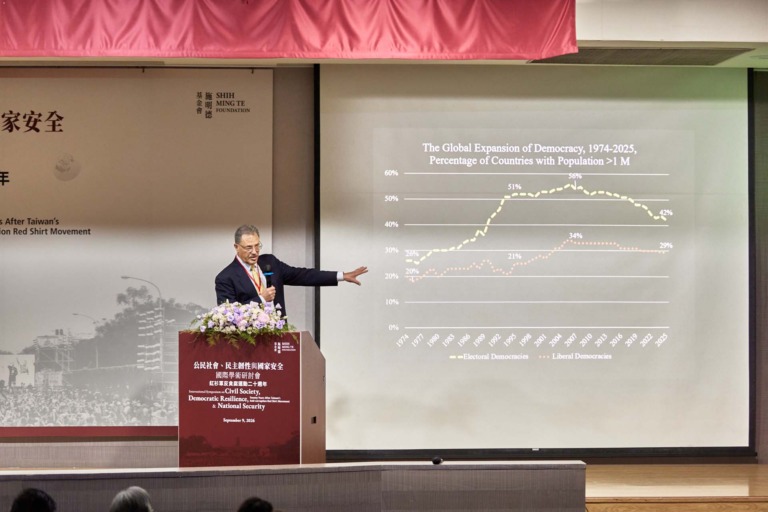
The long historical trajectory is striking. At the beginning of the third wave of democratization in 1974, only about one-quarter of states with populations above one million could reasonably be classified as electoral democracies. By the early 1990s, that proportion had risen above 50 percent, eventually reaching approximately 56 percent around 2006.
Taiwan played an important role in this global democratic expansion. Its first direct presidential election in 1996 marked the completion of a remarkable democratic transition, built through the efforts of civil society, political opposition, and generations of citizens who struggled against authoritarian rule. The peaceful transfer of presidential power in 2000 further demonstrated the depth of that transformation.
Around 2006 and 2007, however, the global trend began to reverse.
Freedom House data illustrate the change clearly. During most years between the end of the Cold War and the mid-2000s, substantially more countries experienced gains in political rights and civil liberties than experienced declines. Beginning in 2006 and 2007, that pattern reversed. For nearly two decades, more countries have declined in freedom than improved.
The deterioration has occurred across regions. Latin America, Central and Eastern Europe, Africa, and parts of Asia have all experienced significant democratic stress. Some democracies have shown considerable resilience, while others have moved steadily toward more restricted political systems.
The United States itself has experienced a significant decline in measures of political rights and civil liberties. That deterioration is especially consequential because democratic erosion in a major established democracy challenges the assumption that democratic consolidation, once achieved, is irreversible.
Taiwan presents a very different picture. Despite severe political polarization and persistent pressure from the PRC through information operations and gray-zone activities, Taiwan has remained a remarkably robust and resilient democracy. Its experience demonstrates that democratic institutions can endure even under substantial internal and external pressure.
▪ The Authoritarian Populist Model
How does contemporary democratic backsliding occur?
The dominant pattern is no longer the classic military coup. Instead, many democracies are eroded gradually by elected leaders who initially operate within democratic institutions but subsequently weaken the constraints on executive power.
The careers of leaders such as Hugo Chávez in Venezuela, Recep Tayyip Erdoğan in Turkey, Narendra Modi in India, and Nayib Bukele in El Salvador illustrate different versions of this broader phenomenon.
Although national contexts differ, authoritarian populism tends to share several characteristics.
The first is anti-elitism. Populist leaders claim that established political, economic, cultural, and intellectual elites have betrayed ordinary citizens and governed with arrogance or contempt.
Such grievances cannot simply be dismissed. Economic inequality, social exclusion, and elite detachment are real problems in many democracies. The danger arises when legitimate grievances are transformed into a sweeping narrative in which virtually all institutions are portrayed as corrupt and illegitimate.
The second feature is therefore anti-institutionalism. Courts, legislatures, universities, independent media, professional bureaucracies, and civil society organizations are depicted not as necessary components of democratic pluralism but as obstacles to the will of “the people.”
Third, authoritarian populism is highly personalistic. Political authority increasingly becomes centered on a leader who claims an exceptional capacity to rescue the nation. Donald Trump’s statement at the 2016 Republican National Convention—“I alone can fix it”—captured this logic of personalistic politics. Once leaders present themselves as uniquely capable of saving the country, institutional constraints can easily be portrayed as illegitimate interference.
Fourth, elections are treated increasingly as plebiscites rather than as one component of a broader constitutional democracy. After winning an election, the leader claims an unrestricted popular mandate. Checks and balances are then presented as obstacles to implementing the will of the majority.
Fifth, authoritarian populists construct politics around enemies. These enemies may be domestic political opponents, minorities, immigrants, journalists, intellectuals, or foreign actors. Political disagreement is transformed into a struggle between an authentic nation and allegedly disloyal or dangerous outsiders.
Finally, this form of politics is often associated with xenophobia and hostility toward liberal internationalism. Immigration has become an especially powerful issue in many advanced democracies. Aging societies may increasingly depend on immigration economically and demographically, while citizens simultaneously demand credible control over national borders. When democratic parties fail to address both sides of this challenge, authoritarian populists can exploit the resulting frustration.
▪ The Autocrat’s Playbook
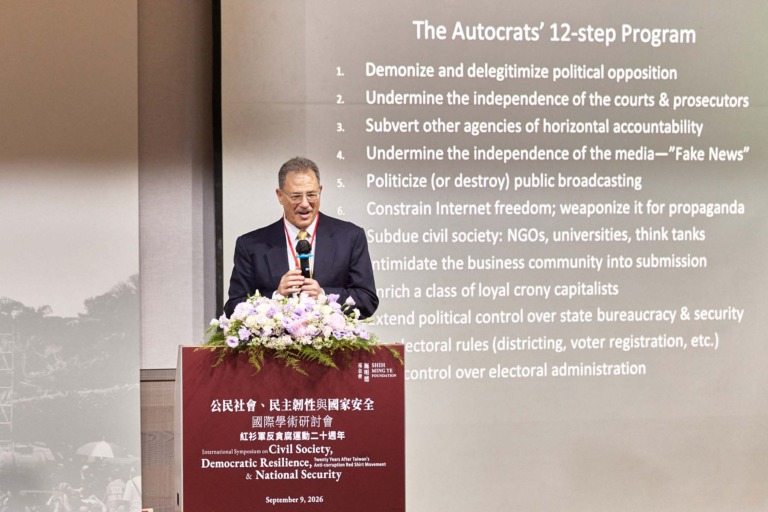
Once authoritarian populists gain power, their behavior often follows a recognizable pattern. I call this the “Autocrat’s Twelve-Step Program.”
This is not a fixed sequence, nor does it require conscious coordination among leaders. Rather, the logic follows naturally from the objective of concentrating and retaining political power.
The first step is to delegitimize the opposition. Political opponents are no longer described merely as mistaken or ineffective. They are portrayed as corrupt, disloyal, or fundamentally outside the legitimate political community.
The next target is the independent media. Critical journalism is labeled “fake news,” hostile media organizations are pressured economically or legally, and public broadcasting may be brought under political control.
The judiciary is another crucial target. Governments seeking unconstrained executive authority attempt to weaken judicial independence, alter the composition of courts, or politicize the institutions responsible for prosecution and law enforcement. Once these institutions are captured, the legal system can cease to function as a constraint on executive power and instead become an instrument against political opponents.
Civil society is also an early and important target. Human rights organizations, independent think tanks, civic associations, and advocacy networks can constrain authoritarian behavior and mobilize resistance. Governments therefore restrict their funding, subject them to tax or regulatory pressure, and criminalize or otherwise burden political criticism.
Independent media outlets may be closed, forced into financially distressed sales, or transferred to politically aligned owners. Business communities may also come under pressure. Companies learn that access to government, favorable regulation, or even their economic survival may depend on support for the ruling party and avoidance of the opposition.
The cumulative effect is to weaken every independent source of political, economic, and informational power.
The final and most dangerous stage is interference with electoral administration itself. Once an incumbent government gains control over the machinery that organizes elections, the distinction between competitive democracy and authoritarian rule becomes increasingly difficult to sustain.
Taiwan’s experience is instructive here. One important source of confidence in Taiwan’s democratic system has been the independence and credibility of its Central Election Commission. Independent electoral administration is a critical, although sometimes underappreciated, foundation of democratic legitimacy.

▪ Why Democratic Decline Has Accelerated
Why has this deterioration occurred?
There is no single explanation, but several developments have converged.
One is the transformation of the information environment. The global democratic recession coincided with the explosive growth of social media. Digital platforms have profoundly altered political communication, enabling unprecedented access to information while simultaneously facilitating disinformation, polarization, manipulation, and attacks on the integrity of the public sphere.
Economic shocks have also mattered. The global financial crisis of 2007–2008 damaged public trust in economic and political elites. The 2003 U.S. invasion of Iraq weakened the credibility of democracy promotion internationally and contributed to a broader retreat from an assertive democratic foreign policy.
At the same time, technological change and globalization have generated substantial prosperity while also contributing to inequality and economic insecurity. Across the United States, Europe, Taiwan, South Korea, and other advanced economies, the distributional consequences of technological transformation have become politically significant.
If democratic systems fail to produce inclusive economic growth, they create fertile ground for populist mobilization. Communities that experience declining employment opportunities, weakened public services, or prolonged economic insecurity may become receptive to claims that established elites have abandoned them.
Populist parties then connect these economic grievances to narratives about immigration, cultural change, national identity, or elite betrayal.
The appropriate democratic response is not to embrace xenophobic or discriminatory narratives. It is to recognize the underlying frustrations and formulate policies capable of addressing them.
Democracy depends not only on constitutional rules but also on performance. Democratic governments must remain responsive to citizens’ material concerns while preserving individual rights, institutional constraints, and political pluralism.
▪ How Democracies Can Push Back
The authoritarian wave is serious, but it is not irreversible.
Recent efforts to resist authoritarian populism suggest several important strategies.
The first is political coalition-building. Authoritarian populists thrive in highly polarized environments. Democratic opposition forces therefore need to bridge ideological and partisan divisions rather than reproduce them.
The experience of opposition campaigns in Turkey illustrates this principle. The campaigns associated with Istanbul mayor Ekrem İmamoğlu emphasized broad political inclusion and what supporters described as a politics of “radical love.” Rather than competing exclusively within narrow partisan constituencies, opposition actors sought to construct a wider democratic front.
This is a central lesson: when democracy itself is at risk, political parties and civil society organizations must be capable of cooperating across traditional ideological boundaries.
Second, democratic forces need greater humility. Established liberal and democratic elites must be willing to acknowledge their own failures, including their inability at times to listen to economically or culturally marginalized communities. Defending democracy cannot mean defending every existing institution or policy without criticism.
Third, opposition movements need positive, issue-based campaigns. It is not sufficient simply to warn voters about authoritarianism. Democratic movements must offer credible alternatives on economic opportunity, public services, social security, governance, and national development.
Fourth, democrats should not abandon patriotism to authoritarian populists. Populist leaders frequently appropriate the symbols of the nation and present themselves as the exclusive representatives of national identity. Democratic forces can respond with a different conception of patriotism: civic patriotism grounded in constitutional principles, equal citizenship, democratic institutions, and national solidarity without xenophobia.
This distinction is crucial. Liberal democracy does not require citizens to reject national identity. It requires that national identity be compatible with pluralism, political equality, and the rights of minorities.
Finally, the challenge is international as well as domestic.
The global balance of power has shifted as authoritarian states such as China and Russia have become more capable and more assertive. They have developed economic, political, informational, and technological tools that can weaken democratic systems beyond their own borders.
The established democracies of Europe, North America, and East Asia therefore need greater confidence, coordination, and resolve. Democratic resilience requires cooperation in protecting information environments, supporting independent media and civil society, defending electoral integrity, strengthening the rule of law, and resisting external coercion and authoritarian influence.
Democracy cannot be defended solely through institutions at home or alliances abroad. It requires both.
▪ Conclusion
The world has moved from a democratic recession toward what increasingly resembles a third reverse wave of authoritarianism.
The central mechanism of this decline has often been authoritarian populism: leaders gain power electorally, exploit polarization and public grievances, delegitimize political opposition, and then systematically weaken the institutions capable of constraining executive authority.
But the trajectory is not predetermined.
Democratic decline can be reversed when political parties overcome fragmentation, civil society remains mobilized, democratic leaders address genuine social and economic grievances, opposition movements build broad coalitions, and citizens recover a conception of patriotism rooted in democratic values rather than exclusion.
At the international level, established democracies must also recognize that the global struggle between democratic and authoritarian models has returned as a central feature of world politics. They need to defend democratic institutions with greater determination while demonstrating that democracy can still deliver accountable government, inclusive prosperity, and political dignity.
The lesson of Taiwan—and of figures such as Shih Ming-teh—is that democracy ultimately depends on more than elections. It depends on principle, accountability, institutional integrity, and the willingness of citizens and political leaders to defend democratic rules even when doing so imposes political costs.
That is how the current authoritarian wave can be halted, and how democratic momentum can begin again.