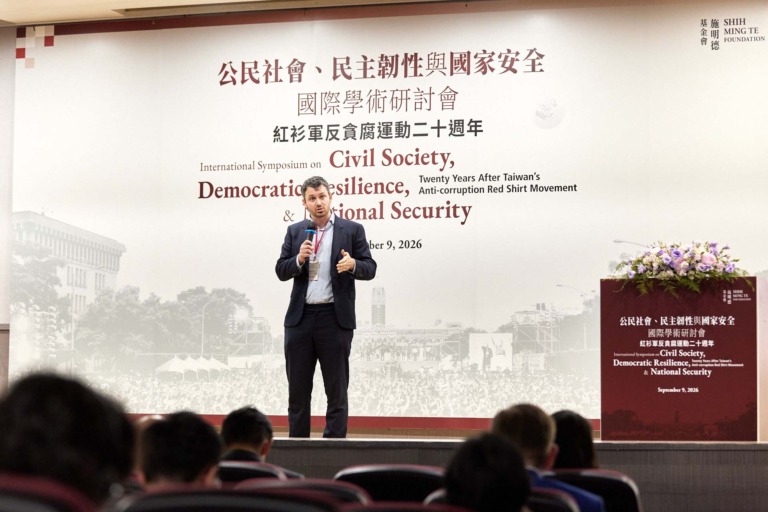
Dr. Eyck Freymann
Hoover Fellow, Hoover Institution, Stanford University
Director, Allied Coordination Working Group
Eyck Freymann is a Hoover Fellow at Stanford and the author of several books, including most recently Defending Taiwan: A Strategy to Prevent War with China.
Abstract
Taiwan is more economically and strategically important to the allied democracies today than it was even a year ago, thanks to AI.
Whatever the U.S. government says and does, it has an abiding structural interest in keeping the Indo-Pacific free and open.
For this reason, China is unlikely to test the United States with a full-scale invasion or blockade of Taiwan. Taiwan’s future is more likely to be determined by a crisis than by a war.
The United States, Taiwan, and their other friends therefore need a strategy to deter a crisis. Today, they may not be prepared psychologically and institutionally for such a crisis.
On the current trend, China will probably continue to intensify its gray-zone campaign until Washington decides to draw the line, or until the people of Taiwan panic. At this moment, there may be a global economic shock.
Taiwan and its friends must think carefully about these scenarios. They must think about how to restore stability by pushing back against China’s gray zone moves in a controlled and proportionate manner and creating strategic communications channels with Beijing.
The people of Taiwan get a vote in how these scenarios unfold. Taiwan’s friends cannot help the people of Taiwan if they are unable to bear psychological pressure short of war. But they can signal their solidarity by supporting Taiwan’s democracy.
Speech
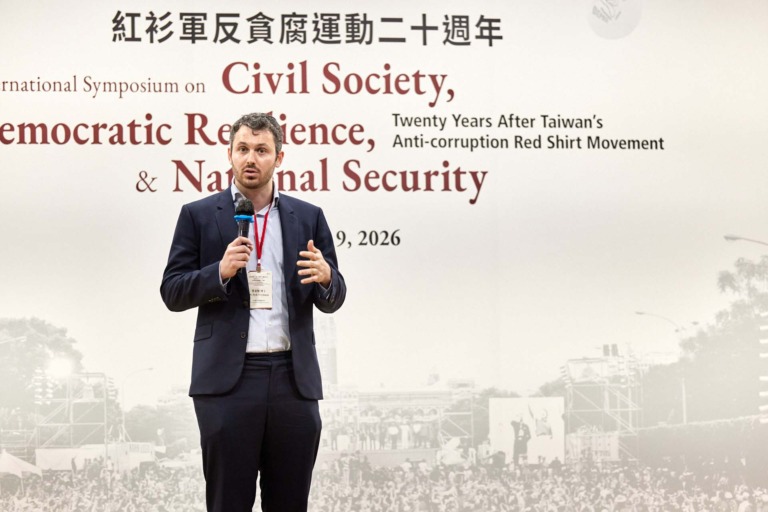
▪ The Strategic Setting
Taiwan today is more economically and strategically important to the United States and other advanced democracies than it was even a year ago. The immediate reason is the accelerating importance of artificial intelligence and the advanced semiconductors on which the AI economy depends. At the same time, the security environment in the Western Pacific remains unstable. The central challenge is therefore not only how to deter a full-scale war over Taiwan, but how to prevent sustained gray-zone pressure from producing a political, financial, or military crisis.
The United States has an enduring structural interest in keeping the Indo-Pacific free and open. Taiwan matters because of its democratic system and its strategic position in the Western Pacific, but also because the regional order depends on the ability of people, goods, and capital to move freely. In political terms, however, semiconductors have become an increasingly immediate way to explain Taiwan’s importance to American audiences. The AI boom has made access to advanced chips central to the valuations and future plans of many of the largest U.S. technology companies.
▪ Semiconductors and the Financial Dimension of a Taiwan Crisis
Taiwan’s economic significance cannot be captured simply by bilateral trade figures. The more consequential issue is the concentration of advanced semiconductor production in Taiwan and the degree to which expectations about AI-driven growth depend on continued access to those chips. A disruption to that supply, or even a meaningful increase in the perceived risk of disruption, could lead investors to reprice major technology companies quickly. The consequences could extend well beyond the technology sector and produce cascading effects across global financial markets.
This creates both leverage and vulnerability. Taiwan’s importance to the global economy gives other countries strong reasons to prevent coercion or disruption. But the same dependence also creates a mechanism through which a Taiwan crisis could become a global financial shock before it becomes a conventional military conflict. Democratic governments therefore need to think not only about military resilience, but also about how their societies and markets would react psychologically and politically to a sudden increase in perceived Taiwan risk.

▪ Why Crisis May Be More Likely Than War
A direct Chinese move that openly cuts off Taiwan’s semiconductor exports would impose clear responsibility for the resulting economic shock. In such a scenario, it would be relatively straightforward for the United States and other governments to identify the source of the disruption and organize a collective response. A more difficult scenario is one in which Beijing gradually changes the practical conditions under which trade with Taiwan can take place, forcing Taiwan or its partners to decide whether and when to resist.
This is why gray-zone pressure against shipping deserves particular attention. Coast Guard operations that contact ships entering or leaving Taiwan, request information about cargoes, or seek compliance with PRC instructions can help establish new expectations without immediately crossing the threshold into armed conflict. If shipping companies, insurers, and other commercial actors begin to comply with such requirements, Beijing could gradually acquire de facto influence over the maritime space around Taiwan without firing a shot.
The strategic effect would be to shift the burden of escalation. Instead of China visibly initiating a blockade, the United States or Taiwan could be placed in the position of deciding whether to challenge an emerging set of restrictions. Any military deployment, sanctions response, or other coercive countermeasure could then be portrayed as the act that turned pressure into crisis. For this reason, Taiwan’s future may be shaped less by the opening moves of a conventional war than by a crisis that emerges from a prolonged contest over what is treated as normal and permissible in the gray zone.
▪ From War Deterrence to Crisis Deterrence
The United States, Taiwan, and their partners therefore need a doctrine for deterring crisis, not only war. China’s gray-zone campaign can continue incrementally so long as each individual step appears too limited to justify a major response. Over time, however, the cumulative effect can alter behavior, expectations, and the distribution of risk. The challenge is to prevent gradual coercion from becoming self-reinforcing while avoiding responses that create an uncontrolled escalatory spiral.
A credible strategy should begin by establishing a common and trusted picture of what is happening in the maritime space around Taiwan. Open-source satellite intelligence, shipping data, and other publicly available information can be combined in a regular reporting mechanism that international governments, firms, insurers, and financial markets regard as credible. Shared situational awareness would make it more difficult for gray-zone measures to remain ambiguous and would give policymakers a stronger basis for calibrated responses.
The second requirement is to think systematically about economic signaling. At present, financial markets may underprice the risk that a gray-zone crisis could disrupt access to advanced chips. One possible objective of policy would be to ensure that markets respond incrementally to changes in coercive behavior rather than only after a major shock. In principle, Taiwan and its partners could connect specific forms of gray-zone pressure to proportionate economic or regulatory responses. Such measures would need to be carefully designed to preserve legitimacy, avoid unnecessary self-harm, and make clear that additional costs follow from additional coercion.
▪ Controlled Pushback and Strategic Communication
Crisis deterrence requires both firmness and control. Taiwan and its friends need to consider in advance which gray-zone moves are unacceptable, what proportionate responses would follow, and how those responses can be coordinated. The objective should not be to react maximally to every provocation, but to prevent incremental coercion from producing irreversible changes in the status quo.
At the same time, any strategy of controlled pushback needs reliable channels for strategic communication with Beijing. In a gray-zone confrontation, the danger is not only intentional escalation but misperception: one side may view a measure as limited and reversible while the other interprets it as preparation for a larger move. Communication cannot eliminate strategic rivalry, but it can help clarify thresholds, intentions, and the conditions under which pressure can be reduced.

▪ Democratic Resilience Under Pressure
The people of Taiwan also have an important role in determining how these scenarios unfold. Gray-zone coercion is designed in part to create uncertainty, fear, and a sense that resistance is futile or prohibitively costly. Taiwan’s partners cannot substitute for the willingness of Taiwanese society to withstand psychological pressure short of war. What they can do is demonstrate that Taiwan will not face such pressure alone.
Support for Taiwan’s democracy is therefore part of crisis deterrence. Political solidarity, credible information, and visible coordination among democratic partners can reduce the effectiveness of coercion aimed at generating panic or isolation. This is especially important because the most consequential moment in a future Taiwan crisis may arrive before shots are fired: when political leaders, markets, firms, and ordinary citizens must decide whether a new form of pressure is temporary, tolerable, or the beginning of a fundamental change in the status quo.
▪ Conclusion
The central strategic problem is not simply whether China will choose to invade or blockade Taiwan. Gray-zone activity is already changing the operating environment around the island, and the cumulative effect of that pressure may eventually force a crisis decision on Taiwan, the United States, or both. A strategy focused only on deterring war risks missing the more likely pathway to instability.
Taiwan and its partners should therefore prepare now for crisis deterrence: building a shared picture of gray-zone activity, developing controlled and proportionate responses, preparing financial and commercial actors for disruption, strengthening public resilience, and maintaining channels of communication that can help contain escalation. The purpose of such a strategy is not to manufacture a crisis, but to restore stability by ensuring that coercive moves do not become cost-free, cumulative, and irreversible.