Ladies and gentlemen, distinguished guests who have traveled far to be here: good morning.
On behalf of the Shih Ming Te Foundation, I extend a sincere welcome to you all. I wish to thank in particular the Department of Political Science at National Taiwan University for co-organizing this symposium, and the delegation from the Hoover Institution for generously agreeing to take part, helping to make today’s conference possible.
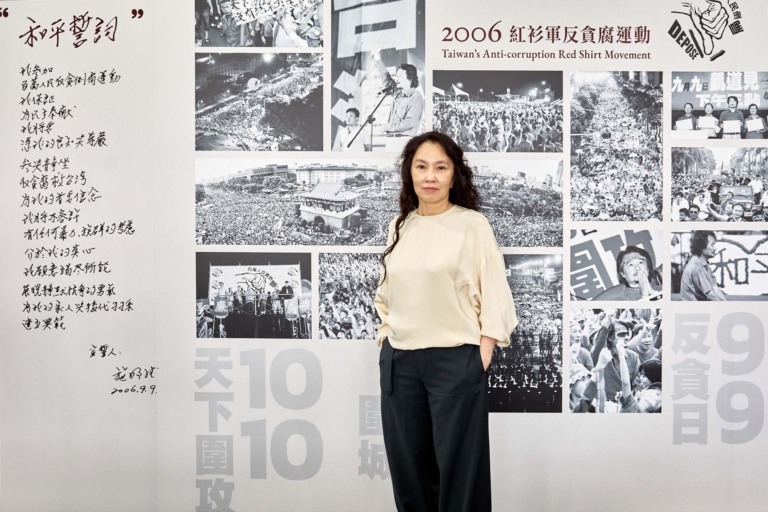
Twenty years ago today, the Red Shirts first took to Ketagalan Boulevard. Taiwan was then marking ten years of direct presidential elections, and was facing a political crisis arising from allegations of corruption within the president’s family. The people of Taiwan responded through civic will, and in doing so demonstrated their insistence on political ethics. Shih Ming Te, the movement’s Commander, held unwaveringly to the principle of non-violence. As a result, a mass movement of extraordinary scale never became a struggle for power. It returned the question of corruption to the courts and to Taiwan’s democratic institutions, and then withdrew peacefully.
What it left behind is not merely an anniversary. It is a test —
of whether a society, at the height of its mobilization, can restrain itself.
A people may be angry without abandoning reason; may challenge those who hold power without dismantling democracy; and must never, because they support a party, cease holding it to account. This is not merely the history of twenty years ago. It is a test that every generation to come must answer anew.
Twenty years on, we convene this symposium not only to look back on a movement, but to begin from that history and consider three challenges that democratic societies now face in common: civil society, democratic resilience, and national security.
Since the seventeenth century, Taiwan has passed through the rule and succession of a series of colonial regimes. Colonial subjects were seldom able to take part in political life as equal citizens, and national security was largely defined unilaterally by those who ruled. Only in 1987, when thirty-eight years of martial law came to an end, did Taiwan formally enter its era of democratic transition. From that time on, civil rights, democratic institutions, and national security gradually became public matters in which the people took part and which they decided together. Another force that has long shaped Taiwan’s fate comes from outside: the international order that took form after the Second World War, and above all the role of the United States in the Indo-Pacific, which has profoundly shaped cross-Strait relations and is an important condition of Taiwan’s national security.
Shih Ming Te stated publicly on many occasions that Taiwan’s democratic movement was moderate and restrained because those who resisted authoritarian rule and challenged power carried, at the same time, a constant concern about the People’s Republic of China’s ambition to annex Taiwan, and bore in their actions a responsibility not to disturb the peace of this region. This was true of both democratic movements he led — the Formosa Movement of 1979 and the Anti-Corruption Red Shirt Movement of 2006. National security has long been a consideration that Taiwan’s democratic movement, from within, could never set aside.
At this moment, Taiwan faces its most complex and most severe national security challenges in decades. The military scale and capabilities across the Strait are no longer of the order they were forty years ago, and the means of pressure are no longer military alone. Gray-zone operations, cognitive warfare, and economic coercion all target the institutional seams and internal vulnerabilities of free and open societies. Because Taiwan stands at the front line of geopolitics and within the world’s critical technology supply chains, its national security has long ceased to be Taiwan’s concern alone.
Nor does the threat come only from outside. Power without checks and balances, party loyalty placed above right and wrong, the collapse of public trust, and public discourse riven by partisanship — each of these can weaken a democracy from within.
One of the questions we must therefore ask today is this —
Can an open society defend itself without becoming another authoritarian state?
I hope that today’s discussions will allow us to consider three questions together:
- First, how can civil society challenge power while preserving democratic order?
- Second, how can democratic institutions confront internal imbalance and self-erosion?
- Third, how can Taiwan safeguard its national security while joining the international community of democracies in defending a free and open way of life?
We are greatly honored to welcome scholars, former government officials, retired senior military officers, and policy experts from the United States, Australia, and Taiwan to this dialogue. The moderators of each session will shortly introduce the speakers and discussants.
Finally, I extend my most sincere welcome and gratitude to our international guests who have traveled so far, to our participants from across Taiwan who have taken time to join us, and to the organizers and fellow participants of the Red Shirt Movement twenty years ago who are with us today. Thank you.