
“The anti-corruption campaign is a social movement; it is the construction, or shaping, of values.” — The Commander’s Confessions, pp. 52–53
July 2007, Goethe University Frankfurt, Germany. Someone asked the commander-in-chief, who had been invited to speak: what, in the end, was the value or achievement of the Red Shirt Movement? He listed six.
First, it opened Taiwan’s era of anti-corruption. In Chinese-speaking societies, “every official is corrupt” was once common knowledge, and graft in office hardly seemed a serious wrong. From then on, opposing corruption became a conviction. He asked in turn: would the wives of Taiwan’s future presidents and senior officials still dare to parade their gold and jewels as before?
Second, it proved that the people of Taiwan have a sense of right and wrong. In an age of rampant materialism, people had assumed that Taiwanese society had grown indifferent, that nothing was anyone’s business. But integrity shows itself in hard times: at the critical moment, the people turned out in full to defend a principle.
Third, it demonstrated the democratic maturity of the people of Taiwan. Images of brawls in the Legislative Yuan had long been notorious around the world. Yet a million people kept the Presidential Office surrounded, their emotions running high, without shedding a single drop of blood.
Fourth, it rooted democratic institutions more deeply. Its strength was unprecedented, yet it refused to stage a coup. After this, a coup in Taiwan became very hard to imagine.
Fifth, it awakened the courage of Taiwan’s judiciary. Before the Red Shirts, Taiwan’s justice system observed the rule that “punishment does not reach the president.” Afterward, the National Taiwan University Hospital administrative council voted fifty-seven to one against the president’s son-in-law returning to practice there, and the president’s wife was indicted for corruption, with the indictment naming the president as co-principal.
Sixth, it strengthened a sense of community among Chinese-speaking people worldwide. And shared memory is history.
As for shortcomings, he named only one: Chen Shui-bian neither resigned nor was forced from office. He took that responsibility upon himself. But he immediately added that had they stormed the Presidential Office, the Red Shirts would no longer have been an “army of democracy” but a “coup force” or a “mob” — an entirely different identity and place in history.
In June 2009, Professor Fang Ning of the Chinese Academy of Social Sciences came to visit. His assessment was that of the anti-corruption movements in three Asian countries, only Taiwan’s had failed, since it did not bring down Chen Shui-bian, while those in the Philippines and Thailand had succeeded.
Shih Ming Te replied on the spot that this conclusion was entirely wrong.
Marcos in the Philippines did fall, but the Philippines did not thereby establish anti-corruption as a value; later presidents were implicated in corruption just the same, and its politicians were no cleaner. In Thailand, the Red Shirts and Yellow Shirts took to the streets in turn, and prime ministers came and went, returned and left again. The anti-corruption movements in both countries not only failed but left endless trouble in their wake.
Taiwan alone was left with no such aftermath. Taiwan dealt with the Chen family’s corruption in the most civilized way, and in 2008 delivered its verdict at the ballot box.
To judge a movement only by whether its target leaves office at once is to misread a social movement as a wager won or lost on the spot. What is precious in a movement — a truly meaningful movement — is its beginning; success may take decades, even a century.
In 1963, Dr. Martin Luther King Jr. gathered more than two hundred thousand people in Washington and delivered “I Have a Dream.” Forty-five years later, America elected its first Black president. And the civil rights movement has still not fully succeeded.
In 1979, when the Kaohsiung Incident occurred, people said Taiwan’s democracy would be set back thirty years. In the end, twenty years later, Taiwan saw its first transfer of power between parties.
The fight against corruption has not yet succeeded. No movement succeeds overnight.
The red tide has receded — not vanished, but waiting for history to call it again.
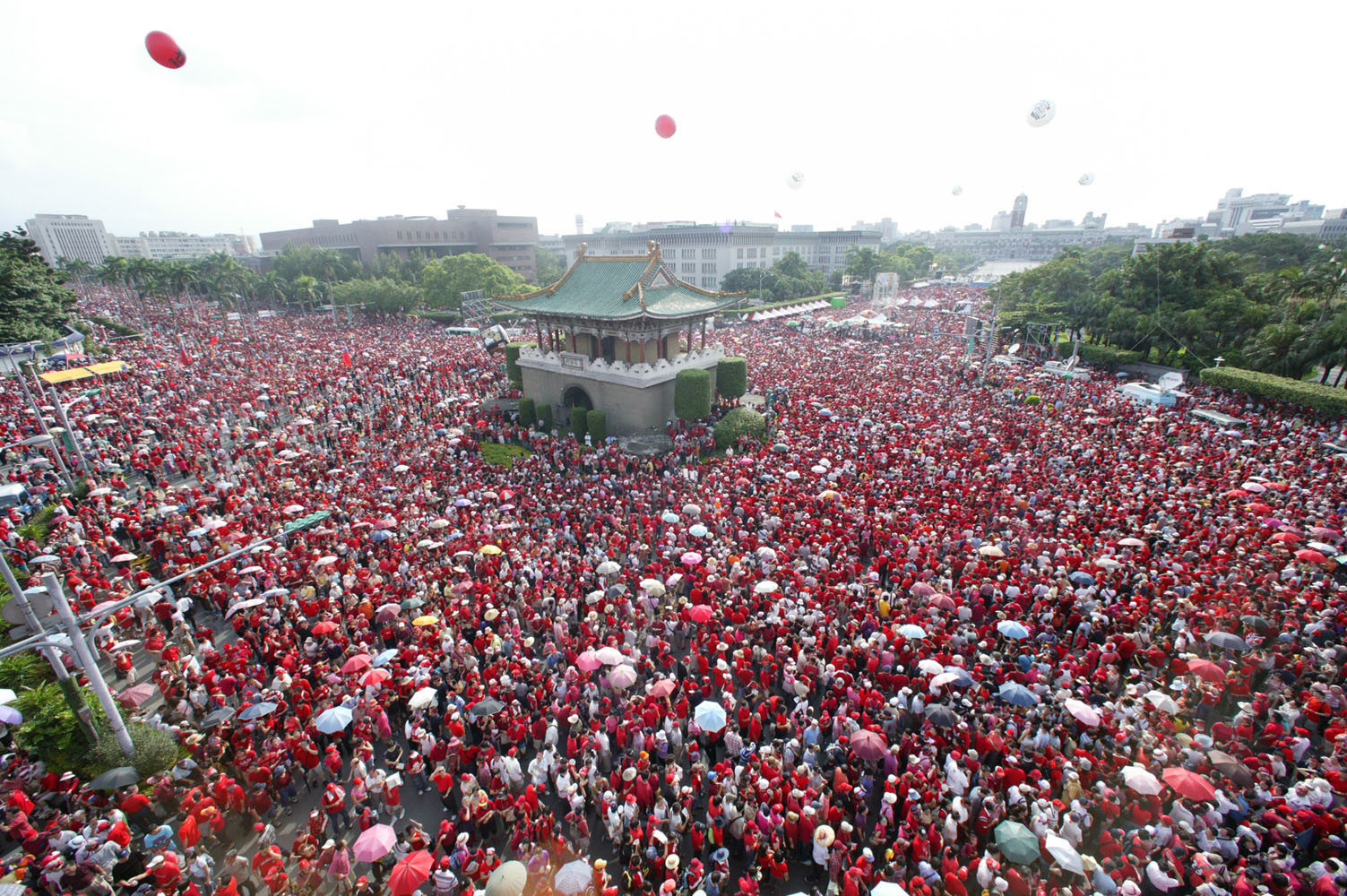
September 9, 2006, Ketagalan Boulevard.
Source: Shih Ming Te, The Commander’s Confessions, 2009, pp. 52–57.

Want to learn more about the Red Shirt Movement and the innermost confessions of its commander-in-chief, Shih Ming Te?
Click here to read more about The Commander’s Confessions and get your copy.
History cares not about length, but about beginnings.
The Shih Ming Te Foundation needs your support.